

From Closed Doors to Digital Spaces: Rethinking Abuse and Control in Family Law: Hertfordshire LFJB Family Law Conference 2026
Following the enormous success of this year's Hertfordshire Family Justice Board (HFJB) Annual Conference on 30 September, Family Paralegal Felicia Martino and Trainee Solicitor Natasha Bassett reflect on the event and its key themes.
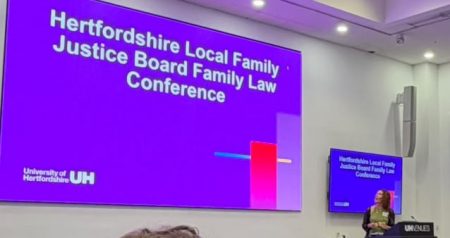
Danielle Peters welcoming guests to the HFJB Conference
This year, the HFJB and its Chair, HHJ Vavrecka, were delighted to welcome the President of the Family Division, Sir Stephen Cobb, alongside a distinguished panel of speakers from legal, policing, academic and clinical backgrounds. More than 100 professionals from across the family justice sector attended the conference, together with students from The Broxbourne School Sixth Form. We were particularly pleased to welcome the students, whose participation helped foster engagement with the next generation on important issues affecting family justice.
"I truly believe the students will take a great deal away from the experience, both in terms of their understanding of Family Law and, perhaps more importantly, their confidence and aspirations for the future. Thank you again for organising such a valuable and memorable day and for giving our students an opportunity that they may not otherwise have had." - Broxbourne School Sixth Form
Delegates gathered to explore some of the most pressing challenges facing the family justice system today, with particular emphasis on the growing role of technology in domestic abuse and the need for effective responses from family justice professionals.
As specialists in family law who regularly advise and support clients experiencing domestic abuse, coercive and controlling behaviour, and safeguarding concerns, we found the conference to be a valuable reminder of the importance of maintaining a thorough understanding of the issues shaping modern family justice and ensuring that the support offered to families remains informed, responsive and effective.
Technology as a Tool for Domestic Abuse
One key theme was the growing use of technology as a tool for domestic abuse. Chris Barnes KC, barrister at 4PB, discussed 'Technology-Facilitated Abuse' and how practitioners should seek to recognise, respond to, and challenge it.
One poignant example was Alcott v Ashworth [2022] EWHC 3687 (Fam) in which the father used a phone provided to a former partner to track her location. He also installed spyware on her computers and encouraged others to monitor her internet searches.
Humanising such issues showed how technology-facilitated abuse can extend the reach of coercive control and amplify the damage caused.
Detective Chief Inspector Richard Fitton, of the Hertfordshire Domestic Abuse Investigation and Safeguarding Team, provided a valuable insight into the changing landscape of domestic abuse. DCI Fitton also used emotive examples from his work to contextualise the issue. He explored how Domestic Abuse Protection Orders (DAPOs) can adapt to the digital world by imposing restrictions around online behaviour and digital access.
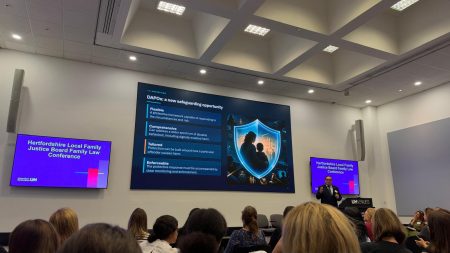
Lived Experiences of Domestic Abuse
The importance of hearing directly from survivors was also significant, bringing the issues discussed into the reality of families' lives. Paul Deakin and Michelle Phillips, Domestic Abuse Practice Development Managers at Cafcass and currently seconded to SafeLives, emphasised the importance of humanising domestic abuse. They introduced us to two domestic abuse survivors who shared moving accounts of their lived experience. They stressed the impact of domestic abuse on both protective parents and children, highlighting that children who may be considered too young to be affected are often carrying significant harm that remains unseen.
"Really interesting conference with excellent and engaging speakers. I got a lot from the women who spoke about their experience of how court proceedings had impacted on family life." - Attendee Feedback Survey
Recognising Children as Victims of Domestic Abuse in Their Own Right
The importance of lived experience was further explored through the recognition of children as victims of domestic abuse in their own right, rather than merely bystanders to the harm inflicted by perpetrators.
Dr Annie Swanepoel, Consultant Child and Adolescent Psychiatrist, highlighted the profound impact domestic abuse can have on children, drawing on evolutionary perspectives to examine its effects on child development and mental health. She stressed that children exposed to domestic abuse have been increasingly recognised both in the law and scientific research as victims in their own right.
Dr Ruth Weir, Deputy Director and Senior Research Fellow in Criminology at the Violence and Society Centre at City George’s, University of London, examined the legal status of children within the context of domestic abuse. In conjunction with Dr Swanepoel, she highlighted the significant legal shift introduced by the Domestic Abuse Act 2021, which, for the first time, recognises children as victims of domestic abuse in their own right.
However, Dr Weir noted that the legislation falls short, as it does not extend this recognition to those under sixteen experiencing abuse within their own relationships. She referenced the role of social media and digital communication in shaping harmful norms around gender, power, and relationships from an early age, with these attitudes often facilitating abusive behaviours and influencing relationship dynamics well into adulthood.
Driving Meaningful Change
The conference highlighted the adaptations already being made in response to an increasingly digital landscape, where technology plays a central role in everyday life, including our relationships. It explored the growing role of technology in domestic abuse, recognising that while it can be exploited to facilitate coercion, control, and other forms of abuse, it can also serve as a valuable tool in identifying risk and supporting victims.
Drawing on lived experience, the conference explored the importance of recovery and rebuilding following domestic abuse. Speakers reflected on how services have developed, and continue to develop, a deeper understanding of the lasting impact of abuse and the support required to help victims recover and move forward. The focus on the lived experiences of domestic abuse was brought into sharper focus through an exploration of the experiences of children, reflecting the growing recognition of their status as victims in their own right.
The importance of keeping children's experiences at the centre of decision-making was also reflected in comments from the President of the Family Division, Sir Stephen Cobb, who addressed delegates just one day after the Court of Appeal handed down judgment in Re C (Child Arrangements Orders; Domestic Abuse; Child Focused Court).
"The conference was very insightful. The speakers made the topic engaging while being conscious of its sensitive nature, and used real-life examples to bring the issues discussed beyond a hypothetical." - Attendee Feedback Survey
The President's Reflections on Re C (Child Arrangements Orders; Domestic Abuse; Child Focused Court) [2026] EWCA Civ 1216
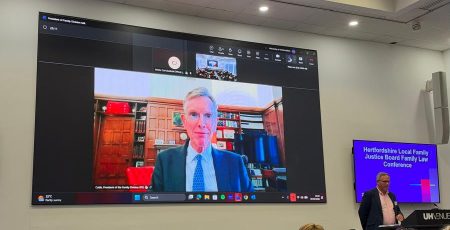
One of the most timely contributions came from the President of the Family Division, Sir Stephen Cobb, who addressed delegates just one day after the Court of Appeal handed down its judgment in Re C (Child Arrangements Orders; Domestic Abuse; Child Focused Court) [2026] EWCA Civ 1216. We were so fortunate to hear Sir Stephen's reflections on the judgment when it was 'hot off the press'!
Reflecting on the decision, Sir Stephen highlighted the central importance of maintaining a child-focused approach in private law proceedings involving domestic abuse. He emphasised that, while the Child Focused Court Model introduces a more investigative and less adversarial process, the legal framework remains unchanged, with children's welfare continuing to be the court's paramount consideration.
The judgment raises important questions about children's welfare, domestic abuse and the operation of the Child Focused Court Model. We will examine the decision and its wider implications for parents, practitioners and the family justice system in a separate article.
Looking Ahead
As domestic abuse increasingly extends beyond closed doors and into digital spaces, the conference recognised the progress already being made across the legal system, policing, academia, specialist support services, and clinical practice, while highlighting the need for frameworks to continue evolving in response to emerging challenges. Above all, it reinforced the importance of placing victims' experiences at the centre of decision-making, recognising both the immediate and long-term impact of abuse on individuals and families.
Conclusion
The Hertfordshire Local Family Justice Board Family Law Conference 2026 provided a valuable opportunity for professionals from across the family justice sector to come together and engage with some of the most significant issues affecting practice today.
"Excellent conference- thoroughly enjoyed, very insightful day." - Attendee Feedback Survey
The event brought together more than 130 total attendees and an outstanding panel of speakers to examine contemporary challenges including digital abuse, coercive control, technology-facilitated harm and the experiences of children affected by domestic abuse. The attendance of students from The Broxbourne School Sixth Form also highlighted the importance of encouraging future generations to engage with issues affecting families, children and wider society.
As Chair of Training for the Hertfordshire Family Justice Board, Danielle Peters played a key role in the planning and delivery of what proved to be a highly successful conference. Together with His Honour Judge Vavrecka, the Hertfordshire Family Justice Board Committee, Geraldine Poulain and colleagues at the University of Hertfordshire, and the event's distinguished speakers, their efforts helped create a thought-provoking and engaging programme that received overwhelmingly positive feedback from delegates.
We would like to thank everyone who contributed to the success of the day. The discussions and insights shared throughout the conference demonstrated the value of bringing together professionals from across disciplines to address complex issues affecting families and children.
We look forward to continuing these important conversations and supporting future Hertfordshire Local Family Justice Board events.
Join our Family Law Team
The conference reinforced the vital role that family law professionals play in protecting and supporting children and families.
If you are a solicitor with experience in child care law, advocacy and public law proceedings, and are looking to further your career within a highly regarded and supportive Family Department, we would be delighted to hear from you.
We are currently recruiting a Child Care Solicitor Advocate (2+ years PQE) to join our specialist team.